- Curriculum
-
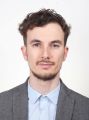
Francesco Ferraresso è un ricercatore a tempo determinato in tenured-track (RTT) presso il dipartimento di Informatica dell'università di Verona da Marzo 2025. La sua ricerca si concentra su aspetti geometrici e spettrali dell'analisi di equazioni differenziali alle derivate parziali, principalmente di tipo ellittico e (semi-)lineare. E' particolarmente interessato alle proprietà spettrali del sistema di Maxwell con dissipazione, anche al fine di modellizzare la propagazione di onde elettromagnetiche attraverso metamateriali e gabbie di Faraday (semi-schermanti). Più di recente si è occupato di modelli matematici per la dinamica di effetti biochimici in correlazione con la malattia di Alzheimer.
E' risultato vincitore di numerosi grant di ricerca nazionali ed internazionali, tra cui il finanziamento di un postdoc di eccellenza di due anni presso l'univerisità TU Graz, tramite il programma ESPRIT della FWF. Ha ricoperto posizioni presso la University of Bern e la Cardiff University. E' stato invitato a presentare la sua ricerca ad importanti eventi internazionali quali the 9th European Congress of Mathematics a Siviglia, al ciclo di seminari online "Spectral Geometry in the Clouds", e al 1st Spectral Theory Workshop a Bristol. E' stato ed è membro di comitati organizzatori per conferenze nazionali ed internazionali quali l'IMSE 2026 Matera. Dal 2022 è membro del UK Spectral Theory Network.
Francesco Ferraresso is a tenured-track lecturer (RTT) at the Dipartimento di Informatica of the University of Verona since March 2025. His research focus on geometric and spectral aspects of partial differential equations, mainly of elliptic type. He is particularly interested in the spectral properties of the dissipative Maxwell system, also in connection with the modelling of the propagation of electromagnetic waves through metamaterials and (semi-insulating) Faraday cages. More recently he has been focusing on mathematical models for biochemical reactions in relations with the Alzheimer's disease.
He has secured several research grants, at a national and international level, among which a 2-years excellence postdoc at TU Graz, in the context of the ESPRIT programme of the FWF. He has worked as postdoctoral fellow at the University of Bern and at Cardiff University. He has been invited to present his research at important international events such as the 9th European Congress of Mathematics in Seville, the cycle of seminars "Spectral Geometry in the Clouds", and at the 1st Spectral Theory Workshop in Bristol. He has been part of the organisation of several national and international conferences, among which the IMSE 2026 conference in Matera. He is a member of the UK Spectral Theory Network since 2022.
Modules
Modules running in the period selected: 5.
Click on the module to see the timetable and course details.
Di seguito sono elencati gli eventi e gli insegnamenti di Terza Missione collegati al docente:
- Eventi di Terza Missione: eventi di Public Engagement e Formazione Continua.
- Insegnamenti di Terza Missione: insegnamenti che fanno parte di Corsi di Studio come Corsi di formazione continua, Corsi di perfezionamento e aggiornamento professionale, Corsi di perfezionamento, Master e Scuole di specializzazione.
Research interests
| Topic |
Description |
Research area |
|
PDEs in connection with biology, chemistry and other natural sciences
|
Well-posedness of systems of semilinear and quasilinear parabolic equations modelling the diffusion and aggregation of Aβ-amyloids in the brain, including chemotactical terms of Keller-Segel type.
|
Mathematical methods and models
Partial Differential Equations
|
|
Maxwell equations
|
Analysis of the spectral properties and spectral approximation of the Maxwell system, even with tensor coefficients and in dispersive media, including metamaterials.
|
Mathematical methods and models
Partial Differential Equations
|
|
Spectral theory and eigenvalue problems for partial differential equations
|
Eigenvalue analysis of elliptic differential operators, possibly of high order. Dependence of the spectrum upon geometrical perturbations, including Hadamard formulae.
|
Mathematical methods and models
Partial Differential Equations
|